Choosing the best Sandwich Box supplier requires more than comparing prices or browsing attractive product photos. A reliable supplier should understand food contact safety, moisture control, transport pressure, and practical customer use. The box must protect sandwiches during delivery, without making them appear crushed, soggy, or careless.
Packaging expert David Luttenberger, Global Packaging Director at Mintel, has stated, “Packaging must protect the product and communicate its value.” This principle fits every Sandwich Box decision. A strong supplier should offer suitable board grades, secure closures, clear specifications, and consistent production quality. Ask for samples before placing a large order. Test them with warm fillings, sauces, lettuce, and refrigerated storage. Check whether the lid closes properly after several minutes. Small details matter.
Do not choose only by the lowest quotation. Cheap materials may soften beside mayonnaise or tear during busy lunch service. Ask about minimum order quantities, printing accuracy, delivery schedules, and quality checks. Request documentation for food-contact materials and confirm that claims are supported by evidence. Sustainability also deserves careful attention. Recyclable board sounds positive, but coatings, adhesives, and local recycling facilities can change the real outcome.
No supplier is perfect. I would still question my first choice after one successful sample. A box that works in a quiet test may fail during a crowded lunchtime. Speak with the supplier’s technical team, not only the sales representative. Their answers often reveal practical experience. The right partnership delivers dependable Sandwich Box packaging, realistic advice, and fewer unpleasant surprises.
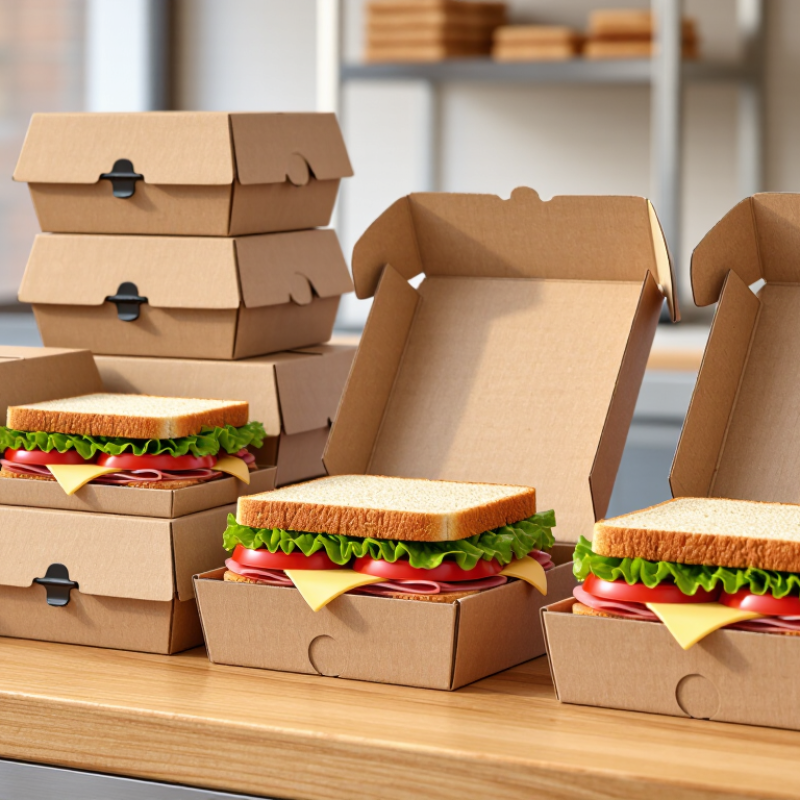
Choosing a sandwich box supplier starts with a precise buying brief, not a catalogue. Define sandwich dimensions, filling weight, stacking height, serving temperature, and expected daily volume. A 2024 food packaging report by Smithers identifies convenience, portion control, and product protection as major packaging demand drivers. Your box must survive delivery without crushing bread or leaking sauces.
Material goals need equal attention. Decide whether you need paperboard, coated board, recycled content, or a compostable structure. Ask for food-contact declarations, migration-test results, and performance data under chilled conditions. The Sustainable Packaging Coalition reports that packaging recovery depends heavily on local collection systems. A recyclable box may not be recycled everywhere. That detail is easy to miss.
Set measurable purchasing goals. Record target unit cost, minimum order quantity, lead time, print quality, storage space, and acceptable defect rates. A practical trial should test a real sandwich, not an empty sample. Check condensation after thirty minutes. Check opening speed during a busy lunch period. Check whether labels peel from cold surfaces.
Do not over-specify.
A thicker box can improve protection but increase freight costs and waste. Your first requirements may be wrong. Review them after one pilot shipment, using breakage, customer feedback, and packing time. The best supplier is the one that can document performance consistently, communicate limitations clearly, and adjust production without hiding inconvenient details.
Choosing the best sandwich box supplier starts with the material, not the printed surface. Paperboard is light, affordable, and easy to recycle. However, oily fillings can weaken it without a suitable barrier. Corrugated fiber offers better strength for delivery. Bagasse can suit businesses seeking plant-based packaging, but moisture resistance must be tested. Ask for food-contact declarations, migration test results, and details about recycled content. A supplier should explain these documents clearly.
Design affects freshness and handling. Small ventilation points can reduce condensation around warm sandwiches. Secure locking tabs prevent the lid from opening during transport. A clear window may improve product visibility, but it can reduce recyclability. Check whether adhesives, inks, and coatings are approved for food contact. Request a physical sample. Digital drawings often hide weak corners and awkward folds.
Size should follow the sandwich, not an estimated average. Measure height after filling, especially with lettuce, sliced tomatoes, or thick bread. A box that is too tight can crush the edges. One that is too large allows movement and sauce leakage. Test several sizes with chilled and freshly prepared products. I would also check stacking strength in a refrigerator and delivery bag. My first choice might still need revision after real handling. Reliable suppliers welcome these tests and record batch quality, production tolerances, and corrective actions.
| Comparison Dimension | Recommended Options | Typical Technical Data | Advantages | Limitations and Checks | Supplier Evidence to Request |
|---|---|---|---|---|---|
| Material: Paperboard | Food-grade folding carton board, coated or uncoated | Common board weights are approximately 250–400 g/m²; moisture resistance depends on the coating and board structure | Lightweight, printable, stackable, and widely recyclable where local facilities accept the coating | Uncoated board can soften from sauces or condensation; laminated structures may reduce recyclability | Food-contact declaration, coating specification, migration test results, and recycled-fiber statement |
| Material: Corrugated Fiberboard | Single-wall corrugated board with food-contact liner | Flute profiles commonly range from about 1.5–4 mm in thickness, depending on the board construction | Higher crush resistance and cushioning than lightweight folding carton board | Uses more storage space; exposed paper edges may absorb moisture; not ideal for very wet fillings without a suitable liner | Board grade, edge-crush or compression data, food-contact declaration, and moisture-resistance test |
| Material: Polypropylene (PP) | Rigid or hinged food container made from food-contact PP | Suitable grades can handle cold foods and, when specifically rated, some hot-food or microwave applications; exact limits must be confirmed by the manufacturer | Good moisture and grease resistance, reusable potential, and strong resistance to many food acids | Higher material use than paperboard; recycling access varies; microwave suitability is product-specific | Resin identification, temperature-use range, microwave statement, migration testing, and recycled-content documentation |
| Material: rPET or PET | Clear hinged or lidded container for chilled sandwiches | Provides high transparency and is generally selected for refrigerated, ready-to-eat products; microwave use is normally not appropriate unless expressly approved | Excellent product visibility, good moisture resistance, and consistent dimensional stability for cold foods | Not suitable for high-heat applications unless specifically designed for them; recycling rules differ by region | Food-contact declaration, recycled-content percentage, clarity specification, and end-of-life guidance |
| Design and Closure | Tuck-end, auto-lock, hinged lid, or tamper-evident closure | Closure should resist opening during stacking, transport, and delivery; tamper evidence requires a dedicated seal or locking feature | Improves presentation, product protection, and customer confidence | Complex structures can increase tooling, assembly time, and material usage | Prototype samples, closure-cycle test, compression test, tamper-evidence description, and dieline approval |
| Size and Internal Fit | Small, standard, or extra-large format selected from the finished product dimensions | Measure internal length × width × height; allow clearance for the sandwich thickness, fillings, and closure movement | Reduces crushing, sliding, wasted space, and excess packaging material | Nominal external dimensions may not equal usable internal dimensions because of board thickness and folds | Dimensioned drawing, tolerance range, filled sample, stacking test, and packed-product photographs |
| Ventilation and Condensation | Vent holes, breathable paper structure, or sealed construction selected according to the filling | Ventilation can reduce condensation but may reduce moisture retention and barrier performance | Helps preserve bread texture and visual quality during short distribution periods | Incorrect venting can cause sogginess, drying, leakage, or reduced shelf life | Condensation trial using the actual recipe, storage temperature, and expected delivery time |
| Food-Safety Compliance | Supplier operating a documented food-contact packaging control system | Relevant evidence may include applicable FDA food-contact requirements, EU Regulation (EC) No. 1935/2004, EU GMP Regulation (EC) No. 2023/2006, and local regulations | Reduces chemical, physical, and microbiological packaging risks | Compliance depends on the exact material, ink, adhesive, coating, food type, contact time, and temperature | Declaration of compliance, migration reports, ink and adhesive details, traceability procedure, and audit records |
| Printing and Inks | Low-migration inks applied to the non-food-contact side | Ink selection must consider direct contact, indirect transfer, drying, set-off, and storage conditions | Supports branding and product information without unnecessarily increasing food-contact risk | Poorly cured ink or excessive set-off can create odor or transfer concerns | Ink technical data sheet, curing controls, set-off assessment, and print-quality sample |
| Quality Control and Traceability | Supplier with batch coding, incoming-material inspection, and documented final inspection | Key checks include dimensions, grammage or thickness, seal strength, print registration, cleanliness, and odor | Makes defects easier to identify, contain, and investigate | A certificate alone does not replace product-specific testing and incoming inspection | Sample inspection report, batch-traceability example, corrective-action process, and quality specification |
| Sustainability and End of Life | Right-sized fiber packaging or recyclable plastic where a suitable collection system exists | Recyclability depends on material composition, coatings, food contamination, local collection, and sorting infrastructure | Can reduce material consumption and improve disposal clarity when accurately labeled | “Compostable” or “recyclable” claims may require specific conditions and should not be treated as universal | Material composition, recycled-content statement, certification scope, disposal instructions, and life-cycle data where available |
How to Choose the Best Sandwich Box Supplier?
Supplier quality should be tested, not assumed. Request food-contact compliance documents, material specifications, and recent batch records. Inspect box edges, folding accuracy, print registration, and grease resistance. A weak corner can collapse under a warm sandwich. The UNEP Food Waste Index Report 2024 estimates that 1.05 billion tonnes of food were wasted in 2022. Reliable packaging cannot prevent every loss, but it can reduce damage, leakage, and premature disposal.
Production capacity requires evidence beyond a large factory photograph. Ask for monthly output, available forming lines, minimum order quantities, and backup equipment. Request lead-time records from the previous six months. Then compare them with your seasonal demand. A supplier producing 500,000 boxes monthly may struggle during a sudden 40% order increase. Confirm inspection frequency, rejection rates, and corrective-action procedures. Perfect forecasts are rare. Your capacity plan should allow mistakes.
Customization should serve performance, not decoration alone. Discuss board thickness, ventilation holes, locking tabs, grease barriers, dimensions, and stacking strength. Request physical samples using your actual sandwich size and filling. The U.S. Environmental Protection Agency reported that containers and packaging represented 28.1% of municipal solid waste generation in 2018. Therefore, ask for material-use data and practical recycling guidance. A lower-material design may appear sustainable, yet fail during transport. Test it honestly. A useful supplier will explain limitations, suggest revisions, and provide repeatable quality results.
How to Choose the Best Sandwich Box Supplier?
Price is only the opening figure. Request a detailed quote for the box, printing, tooling, packing, and delivery. A cheaper unit cost may hide expensive setup fees. Compare the landed cost, not just the factory price. Ask whether prices change with paper grade, box size, or seasonal material costs. I would also request a written quote validity period. Costs can shift quickly.
Minimum order quantities affect cash flow and storage space. A large MOQ may lower the unit price, but unused boxes can become a burden. Ask whether the supplier allows mixed sizes or a smaller trial order. Before approving mass production, inspect samples for folding strength, grease resistance, and print alignment. Small details matter. A box that opens during delivery can damage customer trust. I once focused too heavily on price and overlooked closure strength. That was poor judgment.
Lead time should include artwork approval, sampling, production, and dispatch. Ask for each stage separately. Confirm the supplier’s capacity during busy seasons. Add a practical buffer for inspections or port delays. Shipping terms also need clear wording. Confirm whether the quote uses EXW, FOB, CIF, or another agreed term. Clarify who handles export paperwork, insurance, customs charges, and final delivery. Get carton dimensions and shipment weight before booking freight. Otherwise, the final bill may surprise you. Reliable suppliers provide consistent updates, realistic schedules, and traceable quality records. References from similar food-service buyers can help verify those claims.
Compare indicative sourcing benchmarks before requesting final quotations. Lower unit cost may come with higher minimum orders, longer lead times, or more complex shipping arrangements.
Planning benchmarks for unbranded sandwich boxes: unit prices are shown in USD per box, while minimum order quantities and lead times are shown on separate scales. Confirm whether quotations are EXW, FOB, CIF, or DDP before comparing landed costs.
When sourcing sandwich boxes, start by verifying the supplier behind the product. Ask for current business registration, food-contact compliance documents, factory details, and recent quality audit records. Documents should match the company name and production site. Request samples from a normal production run, not only polished presentation pieces. Check fold accuracy, glue strength, print consistency, and whether the box stays firm around a chilled sandwich. A small crease can reveal weak handling.
Reliable support is more than quick replies. Ask who manages artwork approval, sample changes, inspections, and delivery updates. A capable supplier should explain lead times, minimum order quantities, packaging methods, and corrective actions clearly. Test the process with practical questions. How quickly will they report a damaged carton? Can they provide batch records? Will one contact remain responsible after payment? In purchasing work, vague answers often create extra problems later. A fast reply is not enough.
Long-term reliability appears through repeated evidence. Request delivery records, quality data, and references from comparable buyers when available. Evaluate consistency across several orders, not one successful sample. Check backup plans for material shortages, equipment maintenance, and rejected batches. The supplier should welcome reasonable inspections and document production changes. No supplier performs perfectly every time. A delayed sample may happen. What matters is whether the explanation is honest and the recovery plan is specific. If the sales team promises everything immediately, pause. Trust needs proof.