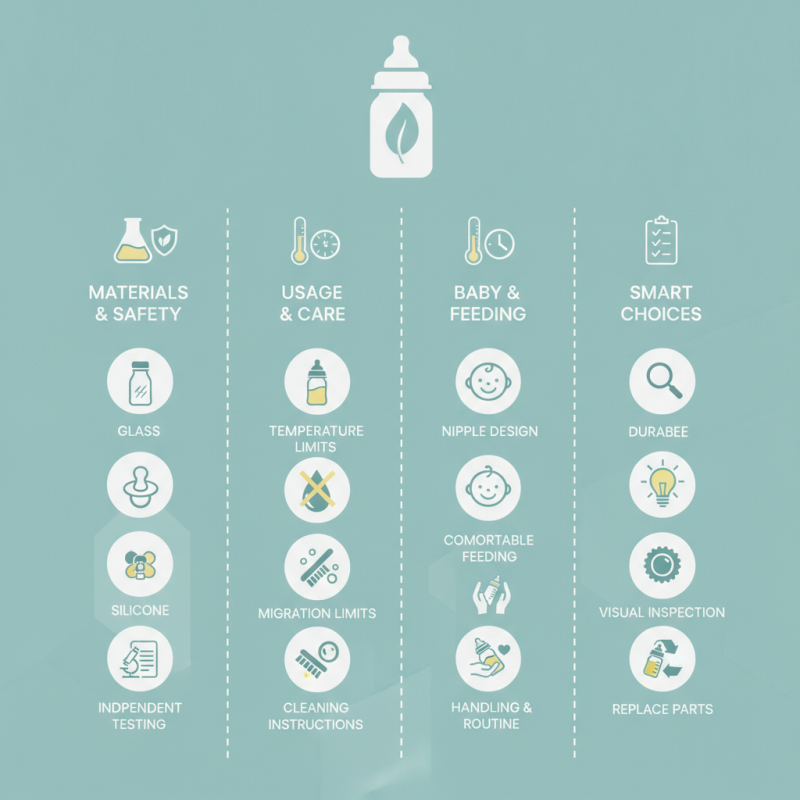
Choosing a feeding bottle bpa free in 2026 requires more than trusting a green label. The bottle touches milk, formula, and a baby’s mouth several times daily. Small details matter, including material, temperature limits, nipple design, and cleaning instructions.
The U.S. Food and Drug Administration reviews food-contact materials, while CDC National Health and Nutrition Examination Survey reports have repeatedly detected BPA metabolites in most tested participants. These findings do not prove that every bottle creates harm. They do show why careful material selection remains reasonable. Dr. Leonardo Trasande, an environmental health researcher, has stated, “BPA is a hormone disruptor.” His comment supports attention to chemical exposure, not panic.
Independent testing can strengthen that decision. Look for clear laboratory documentation, not only “BPA-free” printing on packaging. A useful report should identify the tested material, migration limits, test conditions, and certification date. Check whether the bottle uses polypropylene, glass, silicone, or mixed materials. Glass feels reassuring, but it can break. Silicone nipples may soften over time. Polypropylene is lighter, yet scratches can become difficult to inspect.
This is where shopping becomes less perfect. “BPA-free” does not automatically mean chemical-free. It also does not guarantee safe heating, durable seals, or comfortable feeding. I would compare manufacturer instructions with independent evidence before buying. Examine the bottle under bright kitchen light. Replace cracked parts, cloudy nipples, or stretched valves. The best choice balances verified materials, practical handling, and a cleaning routine caregivers can actually maintain.
Choosing a BPA-free feeding bottle in 2026 requires more than reading a front-label claim. BPA means bisphenol A, a chemical used in some polycarbonate plastics and epoxy coatings. In its 2023 scientific opinion, the European Food Safety Authority set a temporary tolerable daily intake at 0.2 nanograms per kilogram of body weight per day. This replaced the former 4 micrograms limit, a reduction of about 20,000 times.
That number is extremely small. For a 6-kilogram infant, it equals roughly 1.2 nanograms daily. I would not treat “BPA-free” as a complete safety certificate. Check the bottle material, nipple composition, and the supplier’s food-contact compliance statement. Independent migration testing matters more than a bright package claim. Ask whether testing covered hot water, repeated washing, and sterilization. Real use is harsher than a showroom sample.
The European Commission adopted Regulation (EU) 2024/3190, banning BPA in food-contact materials, with limited exemptions and transition periods. Infant feeding bottles already face strict EU controls, but the 2024 measure broadens restrictions across relevant food-contact products. Look for testing against current EU requirements, not an outdated certificate. A 2024 market report from Grand View Research estimated the global baby bottles market at billions of dollars, showing how quickly new products enter shelves. That growth can make verification inconsistent. Materials can also change between production batches. Keep the compliance document. Replace bottles showing clouding, deep scratches, or a persistent odor. I still think “BPA-free” is only the starting point.
Choosing a BPA-free feeding bottle in 2026 requires more than reading the front label. Check the material, intended use, and compliance evidence. FDA 21 CFR requirements address food-contact materials in the United States, while EU Regulation 10/2011 focuses on plastic materials and migration limits. A responsible supplier should provide current test reports for the finished bottle, not only certificates for raw pellets or silicone parts.
Polypropylene, or PP, is lightweight and practical for daily feeding. It usually handles warm liquids well, but repeated heating can cause scratches and clouding. Glass offers a stable surface and is easy to inspect for residue. It is heavier and can break, even with protective sleeves. Silicone feels soft and resists shattering. However, its flexible surface may retain odors if cleaning is incomplete. Material choice matters.
Look closely at the details.
For PP bottles, ask whether the formulation and colorants comply with relevant food-contact limits under FDA 21 CFR and EU 10/2011. For silicone nipples or seals, request separate migration and safety documentation, because EU 10/2011 does not cover every non-plastic material. Check testing conditions, including temperature, food type, and contact time. A bottle marked “BPA free” may still lack complete evidence. I would also inspect the cap, threads, and sealing ring after washing. These small parts often reveal wear first. No choice is perfect. Your cleaning routine and replacement schedule matter too.
Comparing PP, borosilicate glass, and silicone under FDA 21 CFR and EU food-contact rules
The chart uses typical material values: density is shown in g/cm³, while the temperature figure is an indicative upper continuous-use value for the material itself—not a guaranteed limit for a finished bottle. Product instructions, seals, caps, and testing results always take priority.
PP is a plastic commonly evaluated under FDA 21 CFR 177.1520 and is within the scope of EU Regulation 10/2011 for plastic food-contact materials. Glass is not covered by EU 10/2011, and silicone is generally assessed under other applicable food-contact requirements, including the EU Framework Regulation (EC) No. 1935/2004. FDA authorization depends on the specific glass or silicone formulation and intended use.
Choosing a BPA-free feeding bottle should begin with your baby’s feeding pattern, not attractive packaging. BPA-free means the bottle does not contain bisphenol A, but material safety still matters. Check clear care instructions, inspect the nipple, and replace cracked or cloudy parts. Pediatric feeding guidance can help, yet every baby develops differently.
A baby coughing, gulping, leaking milk, or pulling away may need a slower flow. Long feeds, frustration, or falling asleep quickly can suggest the flow is too slow. Watch the baby, not only the printed age range. A neat chart is useful, but it is not a diagnosis.
Smaller bottles may suit newborn feeds and reduce unnecessary waste. Older infants may need more capacity, but a larger bottle should not encourage forced finishing. Keep the nipple partly filled with milk during paced feeding. Hold the bottle nearly horizontal, pause regularly, and allow breaks. These small pauses can reveal hunger or fullness.
I would not change nipple flow after one difficult feeding. Babies have uneven days. That detail is easy to overlook. Check the bottle again after a calm feeding, and record what actually happens.
How to Choose a BPA Free Feeding Bottle in 2026?
BPA-free labeling is only the starting point. Check the bottle’s material, heat limit, and care instructions before buying. A bottle used with boiling water should tolerate at least 100°C sterilization. Look for clear wording, such as “steam sterilizer safe” or “heat resistant to 100°C.” Vague claims are not enough. The temperature rating should apply to the complete bottle, including its cap, seal, and feeding nipple.
Inspect the base and packaging for dishwasher guidance. A reliable rating should specify rack placement, cycle limits, and whether removable parts are included. Top-rack washing is often safer because the lower rack receives stronger heat. Separate the nipple, valve, collar, and bottle before washing. Food residue can hide inside small openings. Allow every part to dry fully. Trapped moisture may create unpleasant odors.
In practical use, I would test one bottle gently before daily use. Fill it with hot water, cool it, and check for warping, cloudiness, leaks, or a loose seal. Then run the washable parts through one recommended dishwasher cycle. Do not guess.
A small mistake matters.
Some bottles survive sterilization but deteriorate after repeated dishwasher cycles. Others remain intact but develop a persistent smell. I once assumed a “dishwasher safe” label covered every component; that assumption was too broad. Recheck the instructions after replacement parts arrive. Heat resistance is not permanent proof of durability, and BPA-free materials still need careful handling. Buy based on tested temperature limits, complete care instructions, and consistent performance rather than attractive wording.
How to Choose a BPA-Free Feeding Bottle in 2026?
A “BPA-free” label is only a starting point. Ask for a recent laboratory report covering bisphenol A, related bisphenols, and food-contact migration. The laboratory should be independent and accredited to ISO/IEC 17025. Check the report number, test date, material, and tested bottle model. A certificate for one product may not cover another. That detail is easy to miss.
EN 14350 compliance adds a useful safety checkpoint for drinking equipment. It covers construction, mechanical performance, and chemical requirements for products used by young children. However, compliance claims still need evidence. The European Commission’s 2023 Safety Gate report recorded 3,412 alerts, with chemical risks representing 32% of notifications. This data shows why material claims deserve careful verification. Do not rely on a clean-looking package.
Tips: Search the bottle, model number, and manufacturer in 2026 recall databases. Check the CPSC, EU Safety Gate, and Health Canada records. Look for recalls involving cracking, leaking, choking hazards, or chemical migration. Compare the recall date with the exact production code. A similar name is not enough. Also inspect the teat, valve, and cap by hand. I have found that unclear instructions often create more doubt than the plastic itself. Replace damaged parts promptly, even when testing documents look convincing.
| Verification Dimension | What to Verify | Reliable Evidence or Threshold | 2026 Buyer Check | Decision Guidance |
|---|---|---|---|---|
| BPA-free claim | Confirm that the bottle, cap, collar, and included accessories are covered by the claim. | A material declaration or laboratory report should identify bisphenol A and the tested components. A marketing statement alone is weaker evidence. | Request the report number, test date, sample description, and laboratory accreditation status. | Prefer documentation that covers the complete feeding set, not only the bottle body. |
| Material identification | Identify the material used for each food-contact part. | Common food-contact materials include glass, polypropylene, silicone, and stainless steel. Material identification should be consistent with the test report and instructions. | Check whether the nipple, valve, seals, and printed markings are included in the material list. | Do not treat a BPA-free bottle body as proof that every component is BPA-free. |
| Third-party laboratory testing | Verify that testing was performed by an independent laboratory rather than supported only by an internal declaration. | Look for an itemized report, laboratory name, accreditation reference, test method, sample identification, and result status. ISO/IEC 17025 accreditation is a useful laboratory-quality indicator. | Confirm that the report matches the exact model, material, capacity, and production version being purchased. | Reject undated screenshots, generic certificates, or reports that do not identify the tested product. |
| EN 14350 reference | Check whether the product is tested against EN 14350, the European standard for drinking equipment intended for children. | The report should state the complete standard designation and the applicable edition, rather than only saying “European standard tested.” | Ask for the conformity report and verify that it applies to the complete bottle assembly. | A general food-contact report is not automatically proof of compliance with EN 14350. |
| Mechanical and physical safety | Review tests for leakage, component security, accessible edges, small parts, and foreseeable use. | A complete EN 14350 test report should identify the relevant physical and mechanical test sections and record pass/fail results. | Check the report against the actual nipple, valve, cap, handles, and anti-choking components supplied. | Avoid products with loose parts, unexplained modifications, or missing assembly instructions. |
| Chemical migration | Confirm that food-contact materials were assessed for migration and restricted substances. | For products sold in the EU, review the applicable food-contact requirements, including Regulation (EC) No 1935/2004 and Commission Regulation (EU) No 10/2011 where plastic materials apply. | Check whether the report lists test simulants, contact conditions, temperature, duration, and measured results. | A “non-toxic” statement without migration conditions is not a sufficient technical result. |
| EU BPA restriction context | Check whether the supplier addresses the current EU restrictions relevant to infant feeding products. | The EU has prohibited the use of BPA in polycarbonate infant feeding bottles and has established additional food-contact restrictions through applicable legislation. | Request the legal basis and product-specific declaration instead of relying on the phrase “EU approved.” | Legal compliance and a voluntary BPA-free claim are related but should be documented separately. |
| Heat and cleaning instructions | Verify maximum temperature, sterilization method, dishwasher suitability, and replacement instructions. | Instructions should specify use limitations and should be consistent with the tested material and construction. | Record whether boiling, steam sterilization, microwave use, and dishwasher cleaning are permitted. | Do not use a product beyond its stated temperature or cleaning limits. |
| Traceability | Confirm that the packaging or product carries a model number, lot code, date code, or other traceability identifier. | A traceable identifier is necessary to match the product with test reports, safety notices, and recall announcements. | Photograph the model and lot information before use and retain the purchase record. | Avoid products with no identifiable model or production information. |
| 2026 recall screening | Search official recall databases using the product category, model number, lot code, and manufacturer information. | Relevant sources include the U.S. Consumer Product Safety Commission recall database, FDA enforcement reports, the European Commission Safety Gate database, and the applicable national product-safety authority. | Record the search date, search terms, database used, and whether the exact model or lot appears in a notice. A database search is not proof that no future recall will occur. | Do not purchase or use an item matching an active recall until the authority provides a remedy or clearance. |
| Recall notice details | If a notice is found, compare the affected product details with the item in hand. | A valid notice normally identifies the hazard, affected model or lot, distribution region, dates, corrective action, and consumer contact route. | Save the official notice URL or reference number with the purchase record. | Treat marketplace warnings and social-media posts as leads, then confirm them through an official authority. |
| Overall selection rule | Use documentation, traceability, instructions, and recall screening together. | The strongest candidate has product-specific third-party evidence, a clearly identified material set, an applicable EN 14350 assessment where relevant, and a documented recall search. | Mark each item as Verified, Needs Evidence, or Do Not Use. | Choose “Verified” only when the evidence matches the exact product and current production version. |
Reference note: EN 14350 and national recall requirements may apply differently according to the sales market, product design, and intended use. Always confirm the current official requirements and recall notices for the exact model and lot.